Khóa học
IELTS Online
IELTS Online
Giảm đến 18%
Đăng ký ngay
Mục lục [Ẩn]
Chủ đề Nature or Nurture – IELTS Reading luôn thu hút thí sinh bởi tính học thuật và chiều sâu về tư duy. Bài viết dưới đây, Langmaster sẽ giúp bạn nắm rõ nội dung, từ vựng quan trọng cùng đáp án chi tiết để chinh phục đề thi này hiệu quả nhất.
Reading Passage
A. A few years ago, in one of the most fascinating and disturbing experiments in behavioural psychology, Stanley Milgram of Yale University tested 40 subjects from all walks of life for their willingness to obey instructions given by a 'leader' in a situation in which the subjects might feel a personal distaste for the actions they were called upon to perform. Specifically, Milgram told each volunteer 'teacher-subject' that the experiment was in the noble cause of education, and was designed to test whether or not punishing pupils for their mistakes would have a positive effect on the pupils' ability to learn.
B. Milgram's experimental set-up involved placing the teacher-subject before a panel of thirty switches with labels ranging from '15 volts of electricity (slight shock)' to '450 volts (danger - severe shock)' in steps of 15 volts each. The teacher-subject was told that whenever the pupil gave the wrong answer to a question, a shock was to be administered, beginning at the lowest level and increasing in severity with each successive wrong answer. The supposed 'pupil' was, in reality, an actor hired by Milgram to simulate receiving the shocks by emitting a spectrum of groans, screams, and writhings together with an assortment of statements and expletives denouncing both the experiment and the experimenter. Milgram told the teacher-subject to ignore the reactions of the pupil, and to administer whatever level of shock was called for, as per the rule governing the experimental situation of the moment.
C. As the experiment unfolded, the pupil would deliberately give the wrong answers to questions posed by the teacher, thereby bringing on various electrical punishments, even up to the danger level of 300 volts and beyond. Many of the teacher-subjects balked at administering the higher levels of punishment, and turned to Milgram with questioning looks and/or complaints about continuing the experiment. In these situations, Milgram calmly explained that the teacher-subject was to ignore the pupil's cries for mercy and carry on with the experiment. If the subject was still reluctant to proceed, Milgram said that it was important for the sake of the experiment that the procedure be followed through to the end. His final argument was, 'You have no other choice. You must go on.' What Milgram was trying to discover was the number of teacher-subjects who would be willing to administer the highest levels of shock, even in the face of strong personal and moral revulsion against the rules and conditions of the experiment.
D. Prior to carrying out the experiment, Milgram explained his idea to a group of 39 psychiatrists and asked them to predict the average percentage of people in an ordinary population who would be willing to administer the highest shock level of 450 volts. The overwhelming consensus was that virtually all the teacher-subjects would refuse to obey the experimenter. The psychiatrists felt that 'most subjects would not go beyond 150 volts' and they further anticipated that only four per cent would go up to 300 volts. Furthermore, they thought that only a lunatic fringe of about one in 1,000 would give the highest shock of 450 volts.
E. What were the actual results? Well, over 60 per cent of the teacher-subjects continued to obey Milgram up to the 450-volt limit! In repetitions of the experiment in other countries, the percentage of obedient teacher-subjects was even higher, reaching 85 per cent in one country. How can we possibly account for this vast discrepancy between what calm, rational, knowledgeable people predict in the comfort of their study and what pressured, flustered, but cooperative teachers actually do in the laboratory of real life?
F. One's first inclination might be to argue that there must be some sort of built-in animal aggression instinct that was activated by the experiment, and that Milgram's teacher-subjects were just following a genetic need to discharge this pent-up primal urge onto the pupil by administering the electrical shock. A modern hard-core sociobiologist might even go so far as to claim that this aggressive instinct evolved as an advantageous trait, having been of survival value to our ancestors in their struggle against the hardships of life on the plains and in the caves, ultimately finding its way into our genetic make-up as a remnant of our ancient animal ways.
G. An alternative to this notion of genetic programming is to see the teacher-subjects' actions as a result of the social environment under which the experiment was carried out. As Milgram himself pointed out, 'Most subjects in the experiment see their behaviour in a larger context that is benevolent and useful to society - the pursuit of scientific truth. The psychological laboratory has a strong claim to legitimacy and evokes trust and confidence in those who perform there. An action such as shocking a victim, which in isolation appears evil, acquires a completely different meaning when placed in this setting.'
H. Thus, in this explanation the subject merges his unique personality and personal and moral code with that of larger institutional structures, surrendering individual properties like loyalty, self-sacrifice and discipline to the service of malevolent systems of authority.
I. Here we have two radically different explanations for why so many teacher-subjects were willing to forgo their sense of personal responsibility for the sake of an institutional authority figure. The problem for biologists, psychologists and anthropologists are to sort out which of these two polar explanations is more plausible. This, in essence, is the problem of modern sociobiology - to discover the degree to which hard-wired genetic programming dictates, or at least strongly biases, the interaction of animals and humans with their environment, that is, their behaviour. Put another way, sociobiology is concerned with elucidating the biological basis of all behaviour.
Questions 14-19
Reading Passage 74 has nine paragraphs, A-I.
Which paragraph contains the following information?
Write the correct letter A-I in boxes 14-19 on your answer sheet.
Questions 20-22
Choose the correct letter A, B, C or D.
Write your answers in boxes 20-22 on your answer sheet.
20 The teacher-subjects were told that they were testing whether
21 The teacher-subjects were instructed to
22 Before the experiment took place the psychiatrists
Questions 23-26
Do the following statements agree with the information given in Reading Passage 74?
In boxes 23-26 on your answer sheet, write:
TRUE if the statement agrees with the information
FALSE if the statement contradicts the information
NOT GIVEN if there is no information on this
>> Xem thêm:
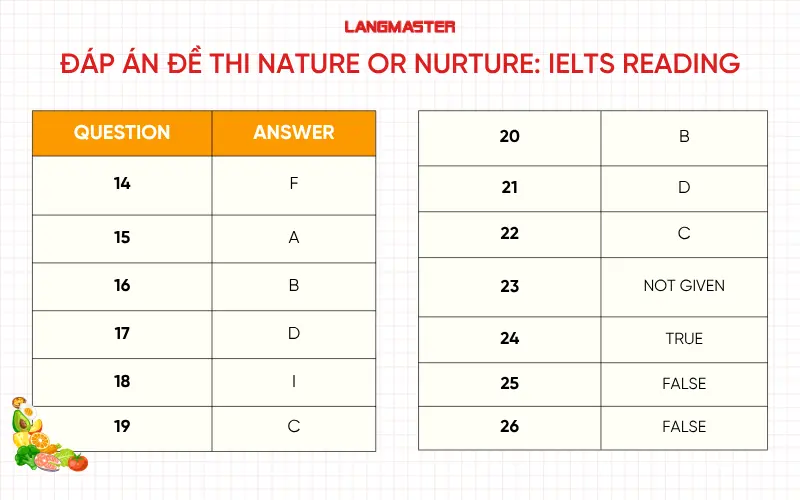
14. Đáp án: F
Thông tin đoạn F: “One's first inclination might be to argue that there must be some sort of built-in animal aggression instinct... this aggressive instinct evolved as an advantageous trait... finding its way into our genetic make-up as a remnant of our ancient animal ways.”
Giải thích: Đoạn này đưa ra lý giải sinh học cho hành vi của các “teacher-subjects”, cho rằng con người có bản năng gây hấn di truyền từ tổ tiên, được hình thành như một đặc điểm tiến hoá.
15. Đáp án: A
Thông tin đoạn A: “Milgram told each volunteer ‘teacher-subject’ that the experiment was in the noble cause of education... designed to test whether or not punishing pupils for their mistakes would have a positive effect on the pupils' ability to learn.”
Giải thích: Milgram giải thích với người tham gia rằng thí nghiệm nhằm kiểm tra tác dụng của hình phạt đối với việc học tập — đây là lý do ông đưa ra để họ đồng ý tham gia.
16. Đáp án: B
Thông tin đoạn B: “The supposed 'pupil' was, in reality, an actor hired by Milgram to simulate receiving the shocks...”
Giải thích: Đoạn này tiết lộ “pupil” không phải là người thật mà là một diễn viên được thuê để giả vờ bị điện giật.
17. Đáp án: D
Thông tin đoạn D: “The psychiatrists felt that most subjects would not go beyond 150 volts... only four per cent would go up to 300 volts... only a lunatic fringe of about one in 1,000 would give the highest shock of 450 volts.”
Giải thích: Đây là dự đoán thống kê mà nhóm bác sĩ tâm thần đưa ra trước khi thí nghiệm diễn ra — cho rằng rất ít người sẽ đi đến mức điện cao nhất.
18. Đáp án: I
Thông tin đoạn I: “Sociobiology is concerned with elucidating the biological basis of all behaviour.”
Giải thích: Mục tiêu chính của sociobiology (xã hội sinh học) là tìm hiểu cơ sở sinh học của mọi hành vi và xem mức độ di truyền ảnh hưởng đến hành vi con người.
19. Đáp án: C
Thông tin đoạn C: “If the subject was still reluctant to proceed, Milgram said that it was important for the sake of the experiment that the procedure be followed through to the end. His final argument was, ‘You have no other choice. You must go on.’”
Giải thích: Đoạn này mô tả cách Milgram thuyết phục người tham gia tiếp tục dù họ do dự — bằng cách khẳng định rằng điều đó “quan trọng cho thí nghiệm” và họ “không có lựa chọn nào khác.”
20. Đáp án: B
Thông tin đoạn A: “Milgram told each volunteer ‘teacher-subject’ that the experiment was in the noble cause of education, and was designed to test whether or not punishing pupils for their mistakes would have a positive effect on the pupils' ability to learn.”
Giải thích: Mục đích mà Milgram nói với người tham gia là kiểm tra việc trừng phạt có giúp học sinh học tốt hơn không — tức là “punishment helps learning.”
21. Đáp án: D
Thông tin đoạn B: “The teacher-subject was told that whenever the pupil gave the wrong answer to a question, a shock was to be administered, beginning at the lowest level and increasing in severity with each successive wrong answer… Milgram told the teacher-subject to ignore the reactions of the pupil, and to administer whatever level of shock was called for, as per the rule governing the experimental situation.”
Giải thích: Người tham gia phải thực hiện việc trừng phạt theo quy tắc của thí nghiệm, không được dừng khi học sinh kêu đau.
22. Đáp án: C
Thông tin đoạn D: “The psychiatrists felt that most subjects would not go beyond 150 volts... only four per cent would go up to 300 volts... only a lunatic fringe of about one in 1,000 would give the highest shock of 450 volts.”
Giải thích: “The psychiatrists felt that most subjects would not go beyond 150 volts... only four per cent would go up to 300 volts... only a lunatic fringe of about one in 1,000 would give the highest shock of 450 volts.”
23. Đáp án: NOT GIVEN
Thông tin đoạn A: “Stanley Milgram of Yale University tested 40 subjects from all walks of life…”
Giải thích: Đoạn này nói rõ rằng những người tham gia đến từ mọi tầng lớp xã hội (“all walks of life”), không nói rằng họ là sinh viên tâm lý học ở Yale.
24. Đáp án: TRUE
Thông tin đoạn F: “A modern hard-core sociobiologist might even go so far as to claim that this aggressive instinct evolved as an advantageous trait, having been of survival value to our ancestors…”
Giải thích: Đúng — đoạn này nói rằng một số nhà xã hội sinh học tin rằng bản năng gây hấn (tức hành vi của teacher-subjects) là cơ chế có lợi cho sự sinh tồn.
25. Đáp án: FALSE
Thông tin đoạn G-H: “The subject merges his unique personality and personal and moral code with that of larger institutional structures, surrendering individual properties like loyalty, self-sacrifice and discipline to the service of malevolent systems of authority.”
Giải thích: Trái ngược với câu hỏi — đoạn này cho thấy cá nhân từ bỏ giá trị riêng để phục tùng quyền lực. Nghĩa là authority mạnh hơn personal values.
26. Đáp án: FALSE
Thông tin đoạn I: “Here we have two radically different explanations... The problem for biologists, psychologists and anthropologists is to sort out which of these two... is more plausible.”
Giải thích: Đoạn này nói rằng vấn đề vẫn chưa được giải quyết (“the problem is to sort out…”), nghĩa là thí nghiệm của Milgram chưa giải quyết được câu hỏi trong xã hội sinh học.
>> Xem thêm: Giải đề IELTS Reading Cambridge 17, Test 3: Palm Oil
Để hiểu sâu hơn bài đọc Nature or Nurture, bạn cần nắm vững những từ vựng học thuật thường xuyên xuất hiện trong các đề IELTS Reading cùng chủ đề. Dưới đây là tổng hợp giúp bạn ghi nhớ và áp dụng hiệu quả.
Nếu bạn đang muốn nâng cao kỹ năng đọc hiểu, đặc biệt là chinh phục các bài như Nature or Nurture – IELTS Reading, thì khóa học IELTS online tại Langmaster chính là lựa chọn lý tưởng. Với hơn 16 năm kinh nghiệm đào tạo và luyện thi IELTS, Langmaster cam kết mang đến cho bạn lộ trình học hiệu quả, giúp phát triển toàn diện cả 4 kỹ năng.
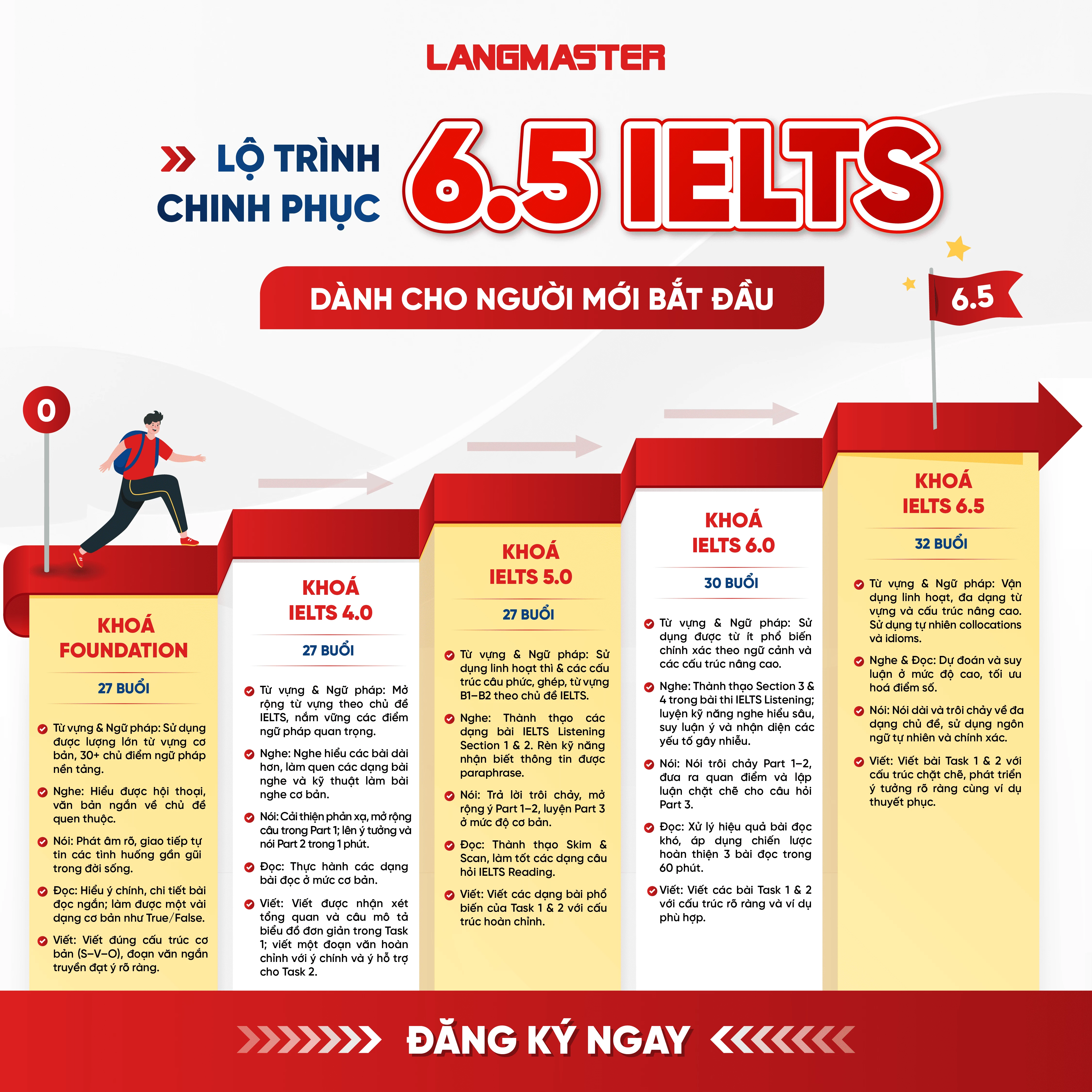
Lớp học được tổ chức theo mô hình nhỏ – tương tác cao (7–10 học viên/lớp), giúp giảng viên dễ dàng theo sát tiến độ từng người học, tránh tình trạng “lớp đông, giáo viên không theo sát”. Đội ngũ giáo viên tại Langmaster đều đạt IELTS 7.5+, được đào tạo bài bản về phương pháp sư phạm và luôn phản hồi, chỉnh bài trong vòng 24 giờ, giúp học viên sửa lỗi và cải thiện liên tục. Nhờ đó, bạn không chỉ hiểu rõ điểm yếu mà còn cải thiện nhanh chóng từng kỹ năng.
Đặc biệt, Langmaster thiết kế lộ trình cá nhân hóa dựa trên mục tiêu band điểm của từng học viên, tránh tình trạng học lan man, học lệch. Ngoài ra còn kèm theo báo cáo học tập chi tiết hàng tháng và cam kết đầu ra bằng văn bản. Bạn còn được học lại miễn phí nếu chưa đạt được band điểm mục tiêu, giúp học viên an tâm tuyệt đối khi đầu tư thời gian và chi phí.
Học online nhưng vẫn đảm bảo chất lượng như học trực tiếp – giáo viên gọi tên, tương tác thường xuyên. Hiện tại, Langmaster đang có chương trình HỌC THỬ MIỄN PHÍ, giúp bạn trải nghiệm lớp học thực tế trước khi bắt đầu hành trình chinh phục IELTS.
Trên đây là phân tích và từ vựng quan trọng trong bài Nature or Nurture – IELTS Reading. Hy vọng bạn đã hiểu rõ cách tiếp cận dạng bài này. Nếu muốn nâng cao kỹ năng Reading và đạt band điểm mục tiêu, hãy tham gia khóa học IELTS online tại Langmaster để được hướng dẫn và luyện tập hiệu quả cùng chuyên gia.





Các dạng bài phổ biến và tiêu chí chấm điểm IELTS Reading chi tiết nhất: Multiple Choice, Matching Information, Matching Headings,... và hướng dẫn chiến lược làm bài hiệu quả

Những sai lầm khi luyện IELTS Reading bao gồm: dịch từng từ, đọc hết cả bài, không đọc câu hỏi trước, không quản lý thời gian, không nắm vững kỹ năng paraphrase, viết sai chính tả
![Giải đề IELTS Reading: A brief history of humans and food [full answers]](https://langmaster.edu.vn/storage/images/2025/09/20/a-brief-history-of-humans-and-food-ielts-reading-answers.webp)
Giải đề thi IELTS Reading “A brief history of humans and food” kèm full đề thi thật, câu hỏi, đáp án, giải thích chi tiết, và từ vựng cần lưu ý khi làm bài.

Tổng hợp IELTS Reading tips hay nhất giúp bạn đọc nhanh, nắm ý chính và xử lý thông tin chính xác, tự tin đạt điểm cao trong kỳ thi IELTS.
![Giải đề IELTS Reading: The importance of law [Full answers]](https://langmaster.edu.vn/storage/images/2025/09/22/55.webp)
Giải đề IELTS Reading “The importance of law” kèm đáp án chi tiết, từ vựng quan trọng và bí quyết luyện thi hiệu quả để nâng cao band điểm.





Hơn 16 năm kinh nghiệm, đào tạo thành công 800.000+ học viên
Phương pháp giảng dạy hiện đại, học viên tiến bộ rõ rệt
Lộ trình học chuẩn quốc tế, phù hợp với nhu cầu thực tiễn
Giáo viên đạt chuẩn Quốc tế với chất lượng top đầu thị trường, giàu kinh nghiệm
Học online linh hoạt, cam kết đầu ra bằng văn bản


![Giải đề IELTS Reading Growing more for less [FULL ANSWER]](https://langmaster.edu.vn/storage/uploads/original/2025/10/22/growing-more-for-less-ielts-reading-answers.png)


.png)